

Planning towards implementation
The planning of the East Railway is progressing in phases towards implementation readiness, following a structured process defined by legislation and supported by comprehensive impact assessments.
Railway infrastructure projects are developed through a structured, phased planning process. For the East Railway, early planning stages assess feasibility and alternative alignments in relation to land use and regional planning frameworks. The planning process includes a statutory environmental impact assessment, evaluating effects on nature, the built environment, natural resources and human well-being.
The general planning phase defines the preliminary route, land requirements and integration with surrounding land use. This is followed by railway planning, which develops a detailed and implementable design, including the precise track alignment.
The planning of the East Railway will take approximately nine years and will continue until 2031. At present, the general planning phase is under way.
Planning phases
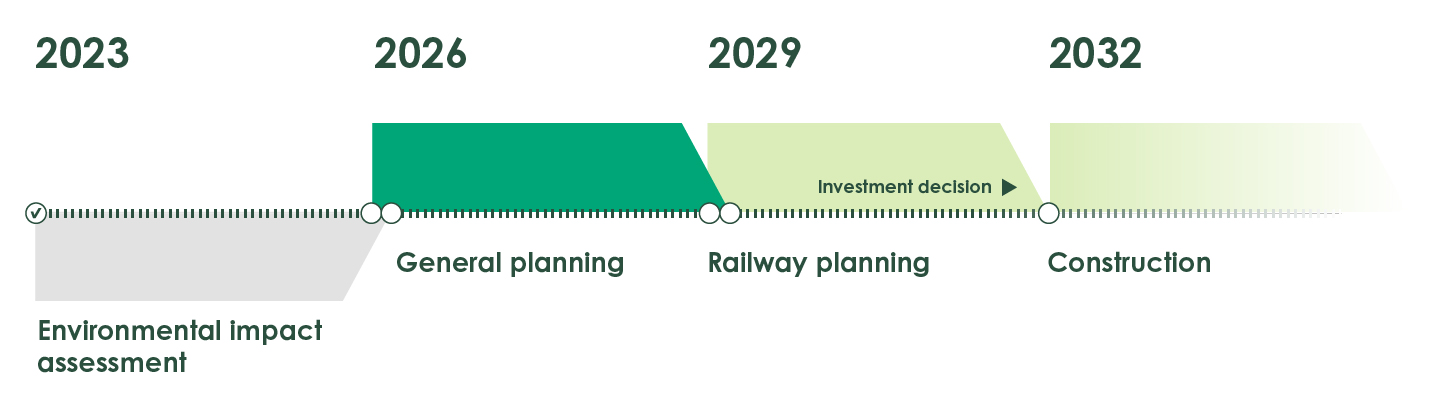
Environmental impact assessment 2024–2026
The environmental impact assessment phase was completed in May 2026. The assessment included a comprehensive evaluation of the project’s impacts on biodiversity, water resources, valuable natural areas and cultural environments, and its results are used to inform planning solutions and to prevent and mitigate adverse impacts.
General planning 2026–2028
The general planning phase is currently under way. It defines the preliminary route of the railway, land requirements and integration of the railway with surrounding land use. During this phase, the railway corridor is refined into an approximately 200-metre-wide planning zone within which the final alignment will be located. The exact alignment will be determined during the subsequent railway planning phase.
Railway planning 2028–2031
The railway planning phase develops the detailed and implementable design. It determines the exact alignment of the track and the land areas required for construction and operation. The plan includes an assessment of the railway’s impacts and identifies the measures needed to prevent, mitigate or compensate for adverse effects arising from construction and railway operations.
No decision has been made on the construction of East Railway or on construction funding. If construction were to begin in 2032, the line could be operational by 2040.